
Many people assume that Pilates is only for people who are already flexible, fit, or experienced in exercise. Others think it is simply a stretching routine and cannot provide a meaningful workout. In reality, Pilates can be adapted to different fitness levels, and beginner-friendly routines can focus on controlled movement, balance, posture, strength, and flexibility. The NHS describes Pilates as suitable for people of different ages and fitness levels, including people who have never done Pilates before.
If you have been thinking about starting Pilates but have no idea where to begin, you are not alone. Seeing advanced reformer exercises or difficult mat movements online can make Pilates look much more complicated than it needs to be. The good news is that Pilates for Beginners starts with the fundamentals. You can learn simple movements first, develop body awareness, and gradually progress as your strength and confidence improve.
Whether you want to exercise at home, join Pilates classes for beginners, improve your core strength, or simply add a low-impact form of exercise to your routine, learning the basics is the right place to start.
In this guide, we will explain what Pilates is, how it works, its potential benefits, beginner exercises, equipment, common mistakes, home workouts, and important safety considerations.
What Is Pilates and How Does It Work for Beginners?
Pilates is a form of exercise that emphasizes controlled movement, breathing, posture, balance, flexibility, and strength. Rather than rushing through repetitions, Pilates encourages you to pay attention to how your body moves and how different parts of the body work together.
The exercises can be performed on a mat or with equipment such as a reformer. Some movements are performed lying down, while others can be done sitting, kneeling, or standing.
For beginners, the objective is not to perform the most difficult exercise possible. It is to learn the basic principles and develop enough control to perform movements comfortably and correctly.
The NHS notes that Pilates focuses on areas including balance, posture, strength, and flexibility, and its beginner sessions can be performed without previous Pilates experience.
Controlled Movement
Controlled movement is one of the most important ideas in beginner Pilates.
Instead of using momentum to complete an exercise, you focus on performing each movement deliberately. This can make you more aware of your position, movement range, and technique.
For example, during a Pilates bridge, you gradually lift and lower your pelvis instead of quickly pushing your body upward. During leg circles, you control the movement of your leg while attempting to maintain comfortable control through your pelvis.
This approach can help beginners learn:
- How their body moves
- How to coordinate different body parts
- How to control exercise movements
- When an exercise needs to be modified
- How to work within a comfortable range of motion
Controlled movement does not mean every Pilates exercise has to be extremely slow. The appropriate speed depends on the exercise and your ability to maintain control.
Breathing and Concentration
Breathing is another important component of Pilates. Beginners should breathe comfortably rather than holding their breath while trying to complete a difficult movement.
Some Pilates approaches coordinate inhalation and exhalation with specific parts of an exercise. However, beginners do not need to become experts in breathing patterns before starting.
A simple approach is to:
- Begin in a comfortable position.
- Breathe naturally.
- Avoid unnecessary breath-holding.
- Coordinate breathing with movement when comfortable.
- Keep your shoulders and face relaxed rather than creating unnecessary tension.
Pilates resources from NHS physiotherapy services also emphasize breathing and controlled movement as important elements of Pilates practice.
Core Awareness and Stability
Pilates core strength is one of the most commonly discussed benefits of this type of exercise.
The core includes muscles around the trunk that contribute to stability and movement. These muscles work together with the hips, spine, shoulders, and legs during everyday activities and exercise.
Beginner exercises can challenge core stability in different ways. For example, toe taps involve moving the legs while maintaining control through the trunk. A bridge combines hip movement with trunk control.
The goal is not simply to “tighten your abs” throughout the entire workout. Good core control involves coordinating your breathing, trunk, pelvis, and limbs during movement.
This is why best Pilates exercises for beginners to build core strength are generally those that can be performed with good control and modified according to the individual’s ability.
Alignment and Body Awareness
Pilates also encourages awareness of body positioning and movement.
This does not mean that there is one perfect posture that everyone must maintain all day. Your body naturally changes position during walking, sitting, standing, exercising, and resting.
Instead, Pilates can teach you to pay attention to:
- Your spinal position
- Pelvic movement
- Shoulder positioning
- Hip movement
- Breathing
- Balance
- Overall movement control
Developing body awareness can make it easier to recognize when an exercise feels comfortable, too difficult, or in need of modification.
Is Pilates Suitable for Complete Beginners?
Yes, Pilates can be adapted for people who are new to exercise. You do not need to be flexible or physically advanced before starting.
The important factor is choosing exercises that match your current ability.
Someone who regularly exercises may be able to start with more challenging movements, while someone with no exercise experience may benefit from basic exercises first.
A beginner-friendly Pilates session may include:
- Breathing exercises
- Pelvic tilts
- Gentle bridges
- Basic leg movements
- Simple mobility exercises
- Supported balance exercises
The NHS specifically provides Pilates workouts suitable for beginners and notes that people do not need previous Pilates experience to participate.
Why Beginners Should Start With Foundational Movements
Imagine trying to learn an advanced exercise before understanding how to control your pelvis, coordinate your breathing, or stabilize your trunk. You may become frustrated or compensate by using unnecessary movements.
Starting with the basics gives your body time to become familiar with Pilates.
A sensible progression is:
Learn → Control → Practice → Progress
First, learn the movement. Then work on controlling it. Once you become comfortable, you can gradually increase the challenge.
Progress does not always mean doing more repetitions. It can also mean improving your technique, increasing your movement range, or learning a slightly more challenging variation.
Why Technique Matters More Than Advanced Exercises
A common mistake among people starting Pilates is comparing themselves with experienced practitioners online.
An advanced exercise may look simple but require considerable strength, coordination, mobility, or balance.
For a beginner, performing a simpler movement correctly can be much more useful than attempting an advanced movement without adequate control.
Your first goal should be quality of movement, not complexity.
7 Benefits of Pilates for Beginners
Starting any new exercise program raises an important question: What can Pilates actually do for me?
Pilates can be used as part of a broader fitness routine and may help develop areas such as strength, flexibility, balance, posture, and body awareness. NHS resources describe Pilates as an exercise approach involving strength, flexibility, balance, posture, and controlled movement.
However, results vary from person to person. Your progress depends on factors such as your starting fitness level, exercise selection, consistency, and individual circumstances.
Here are seven potential benefits worth understanding.
1. Pilates Helps Build Core Strength
One of the main reasons people choose Pilates is to work on core strength and stability.
Your core contributes to the control of your trunk during activities such as walking, bending, lifting, reaching, and exercising. Pilates exercises can challenge these muscles through controlled movements rather than relying solely on heavy resistance.
For example, a beginner might perform:
- Pelvic tilts
- Bridges
- Toe taps
- Modified single-leg movements
- Controlled abdominal exercises
These exercises can be adjusted depending on your ability.
How Pilates Supports Core Training
A beginner Pilates routine can help you practice:
- Trunk stability
- Pelvic control
- Movement coordination
- Breathing during exercise
- Controlled abdominal movement
- Muscular endurance
The goal is not to keep your stomach pulled in as hard as possible. Instead, focus on coordinated and controlled movement.
If an exercise causes you to hold your breath or lose control, the movement may be too challenging at that stage.
2. Pilates Supports Flexibility and Mobility
If you spend much of your day sitting at a desk or remaining in one position, you may notice stiffness or reduced movement in certain areas.
Pilates for flexibility incorporates controlled movements that can take different parts of the body through appropriate ranges of motion.
It is useful to distinguish flexibility from mobility.
Flexibility generally refers to the ability of muscles and surrounding tissues to lengthen, while mobility involves the ability to move a joint or body segment through a range of motion with control.
Beginner Pilates exercises can incorporate both.
Depending on the routine, you may work on:
- Hip mobility
- Spinal movement
- Shoulder mobility
- Hamstring flexibility
- General movement control
Exercises such as leg circles and gentle spinal movements can be included in a beginner routine.
The goal is not to force your body into an extreme position. Instead, work within a comfortable range and gradually develop control.
3. Pilates May Improve Balance and Body Awareness
Balance is an important part of everyday movement. You use balance when walking, changing direction, climbing stairs, standing, and reaching.
Pilates exercises can challenge balance and coordination in different positions.
For beginners, balance exercises should be appropriately modified. Someone who struggles with standing balance may benefit from using a stable support, while someone with better control may eventually progress to more challenging variations.
Pilates can also encourage body awareness because you are constantly paying attention to movement, positioning, breathing, and coordination.
A simple standing exercise might involve gently transferring your weight from one leg to another while keeping a stable support nearby.
This can help you practice:
- Weight shifting
- Body positioning
- Coordination
- Stability
- Movement confidence
Balance exercises should be approached carefully if you have significant balance difficulties.
4. Pilates Supports Postural Awareness
Many people discover Pilates because they want to improve their posture, particularly if they spend long hours sitting at work.
Pilates for posture can involve exercises that encourage awareness of the spine, pelvis, shoulders, and trunk.
However, posture is not simply about sitting or standing perfectly straight all day. Human movement is dynamic, and your body naturally changes position.
Instead of trying to maintain one rigid posture, Pilates can help you develop awareness and control during different movements.
Beginner Pilates exercises for better posture may include movements that work on:
- Trunk strength
- Spinal mobility
- Shoulder movement
- Hip control
- Body awareness
A bridge, for example, can involve coordination between the hips and trunk. Other Pilates movements can introduce controlled spinal movement.
If you experience persistent discomfort related to your posture or movement, an individualized assessment may be more appropriate than simply following a general exercise routine.
5. Pilates Provides a Low-Impact Exercise Option
Many beginners prefer low impact Pilates because it generally avoids the repetitive jumping and high-impact movements found in some other workouts.
A large number of Pilates exercises are performed on a mat, seated, lying down, or in controlled standing positions.
This can make Pilates an appealing option for people looking for a lower-impact form of exercise.
However, low-impact does not mean that every exercise is suitable for everyone.
A Pilates movement can still be physically demanding. Someone recovering from an injury, dealing with persistent pain, or managing a health condition may need exercise modifications or professional guidance.
Pilates can complement other forms of physical activity such as walking, strength training, cycling, or other fitness activities.
6. Pilates Encourages Concentration and Controlled Breathing
Pilates is not just about moving your arms and legs. It also encourages you to pay attention to the movement.
When learning a new exercise, concentration can help you focus on:
- Your starting position
- Breathing
- Movement range
- Coordination
- Exercise technique
- Body awareness
Breathing also plays an important role.
Instead of holding your breath when an exercise becomes difficult, aim for comfortable breathing throughout the movement.
A simple beginner approach is to inhale naturally, exhale comfortably, and coordinate breathing with the movement when it feels appropriate.
This combination of movement and concentration is sometimes described as the Pilates mind-body connection.
You do not need to make your first workout complicated. The goal is simply to become more aware of what you are doing.
7. Pilates Can Be Adapted to Different Fitness Levels
Perhaps one of the most useful characteristics of Pilates for beginners is its adaptability.
A person who has never exercised before will not necessarily need the same routine as an experienced athlete.
Exercises can be modified by changing:
- Movement range
- Repetitions
- Position
- Exercise variation
- Equipment
- Level of support
This makes it possible to create a beginner Pilates workout routine that starts at a manageable level.
Progression can then happen gradually.
For example, you might begin with a basic bridge. Once you can perform it comfortably with good control, you may eventually move toward a more challenging variation.
The important point is that progression should be based on your ability rather than comparison with someone else.
How to Start Pilates for Beginners With No Experience
If you have never tried Pilates before, your first workout does not need to be complicated.
You can begin with a small number of foundational exercises and gradually develop your routine.
Step 1: Choose a Comfortable Space
If you want to try Pilates for beginners at home without equipment, start by preparing a suitable space.
You need enough room to lie down, move your arms and legs, and change positions safely.
An exercise mat can make floor-based exercises more comfortable, but specialized Pilates equipment is not essential for many beginner movements.
Wear comfortable clothing that allows you to move freely.
Step 2: Learn Comfortable Breathing
Start by lying or sitting comfortably and practicing relaxed breathing.
Avoid holding your breath.
As you become more familiar with Pilates, you can learn how breathing coordinates with different exercises.
Step 3: Start With Basic Exercises
Do not immediately attempt advanced movements.
Begin with exercises such as:
- Pelvic tilts
- Bridges
- Gentle leg movements
- Toe taps
- Simple balance exercises
The exact exercises should be selected according to your ability.
Step 4: Focus on Technique
When starting Pilates, technique is more important than completing a large number of repetitions.
Move through a comfortable range and avoid forcing the movement.
If an exercise feels too difficult, make it easier rather than trying to push through poor technique.
Step 5: Progress Gradually
Once your beginner Pilates exercises feel comfortable, you can gradually increase the challenge.
Progress might mean:
- More controlled repetitions
- A slightly larger movement range
- A more demanding exercise variation
- Less external support
- Greater coordination
You do not need to progress every workout.
10 Best Pilates Exercises for Beginners
Once you understand the basic principles, you can start exploring simple Pilates exercises for beginners.
The following exercises are commonly used as beginner-friendly movement patterns. They should be performed within a comfortable range and adapted when necessary.
1. Pilates Breathing
Begin in a comfortable lying or seated position.
Relax your shoulders and breathe naturally. Focus on allowing your breathing to remain smooth while maintaining a relaxed body position.
Beginner Tip
Do not force deep breaths or hold your breath. The goal is to become comfortable coordinating breathing with movement.
2. Pelvic Tilt
Lie on your back with your knees bent and feet supported.
Gently move your pelvis through a small, comfortable range while keeping the movement controlled.
The purpose is to develop awareness of pelvic movement rather than forcing your lower back into a particular position.
Beginner Tip
Keep the movement small at first. Focus on control rather than how far you can move.
3. Pilates Bridge
Lie on your back with your knees bent and feet supported.
Gradually lift your pelvis while maintaining control, then slowly return to the starting position.
The bridge can involve the hips and trunk and is commonly included in beginner Pilates and core exercise programs. NHS physiotherapy materials also describe shoulder bridge as a Pilates/core exercise involving controlled lifting and lowering.
Beginner Tip
Avoid lifting higher simply because you can. Use a comfortable range and avoid creating unnecessary strain in your lower back.
4. Leg Circles
Lie comfortably on your back and position one leg for the movement.
Make small, controlled circles with the leg while attempting to maintain comfortable control through your pelvis.
Beginner Tip
Start with small circles. If your pelvis moves excessively, reduce the circle size or choose an easier variation.
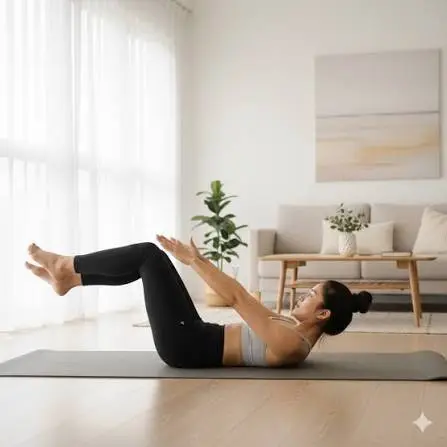
5. Single Leg Stretch
This exercise introduces controlled movement of the legs while maintaining trunk control.
Beginners can use a modified version with a smaller range of movement if the traditional version feels too challenging.
Beginner Tip
Do not sacrifice breathing or control just to complete more repetitions.
6. Toe Taps
Lie on your back in a comfortable position.
Move one leg at a time in a controlled tapping motion while maintaining appropriate trunk control.
Beginner Tip
If lowering the leg is difficult, reduce the range of movement.
7. Spine Stretch Forward
Sit comfortably with your legs positioned in a way that allows you to maintain balance.
Gradually move forward through a comfortable range without forcing your spine or hamstrings.
Beginner Tip
You do not need to reach your toes. The focus is controlled movement rather than achieving a deep stretch.
8. Side-Lying Leg Lifts
Lie comfortably on your side.
Keeping your body stable, slowly lift and lower the upper leg through a manageable range.
This movement can challenge the muscles around the hip and encourage pelvic control.
Beginner Tip
Keep the movement controlled rather than swinging the leg.
9. Modified Swimming Preparation
Begin in a comfortable position and practice controlled alternating movement of the arms and legs.
A beginner version can involve very small movements before progressing to a more demanding variation.
Beginner Tip
Avoid excessive lifting or arching through your back. Focus on controlled coordination.
10. Standing Pilates Balance Exercise
Stand near a stable support if needed.
Practice shifting your weight from one leg to the other or briefly lifting one foot while maintaining control.
Balance exercises can be adapted to different levels of difficulty. NHS physiotherapy resources use standing balance exercises to develop balance, body awareness, and muscle strength.
Beginner Tip
If you feel unsteady, keep one hand close to a stable support and avoid challenging yourself beyond your current balance ability.
Easy Pilates Workout for Beginners at Home Without Equipment
You do not necessarily need a reformer or a large collection of equipment to begin Pilates.
An easy Pilates workout for beginners at home can be built around simple mat-based movements.
A practical beginner session could look like this:
1. Breathing and Preparation — 3 Minutes
Begin with comfortable breathing and gentle movement.
2. Pelvic Tilts — 2 Minutes
Practice controlled pelvic movement.
3. Bridges — 3 Minutes
Perform comfortable bridge movements with appropriate rest.
4. Toe Taps — 3 Minutes
Use a small range of motion and modify as needed.
5. Side-Lying Leg Lifts — 3 Minutes
Perform controlled movements on each side.
6. Standing Balance — 2 Minutes
Practice supported balance near a stable surface.
7. Cool-Down — 4 Minutes
Finish with comfortable breathing and gentle movement.
This creates an approximately 20 minute Pilates workout for beginners at home. It is an example of how a session can be organized rather than a universal prescription for every person.
If you have an injury, persistent pain, a medical condition, or recently underwent surgery, get appropriate professional advice before starting a new exercise routine. The NHS similarly recommends seeking healthcare advice when you are unsure whether a Pilates workout is appropriate for your health or fitness level.
Pilates Equipment for Beginners: Do You Need a Reformer or Mat?
A common question among people starting Pilates is whether they need expensive equipment.
The answer is usually no.
Many beginner mat Pilates exercises can be performed with little or no equipment.
Mat Pilates
Mat Pilates uses bodyweight and controlled movements performed on a mat or comfortable surface.
It can be a practical option for people who want to exercise at home.
Reformer Pilates
A Pilates reformer is a specialized piece of equipment that uses springs, straps, and a moving carriage to provide resistance and support.
Reformer exercises can be adapted to different levels, but learning with an appropriately qualified instructor can be helpful, particularly if you are completely new to Pilates.
Useful Pilates Equipment for Beginners
Depending on your goals, optional equipment may include:
- Exercise mat
- Resistance bands
- Small Pilates ball
- Foam roller
- Reformer equipment
You do not need to purchase everything at once.
If you are practicing Pilates workout without equipment, focus on learning the movement fundamentals first.
Common Pilates Mistakes Beginners Should Avoid
Even simple exercises can become difficult if you rush through them or choose a level that is too advanced.
Trying Advanced Exercises Too Soon
Watching an experienced Pilates instructor perform a difficult movement does not mean you should immediately copy it.
Build your foundation first.
Holding Your Breath
When an exercise feels difficult, some people automatically hold their breath.
Try to maintain comfortable breathing instead.
Using Too Much Range of Motion
A bigger movement is not necessarily a better movement.
Start with a range that you can control.
Ignoring Pain or Unusual Symptoms
Muscular effort during exercise can be normal, but significant or worsening pain should not simply be ignored.
Stop an exercise if you feel unwell or develop concerning symptoms. NHS guidance similarly advises stopping exercise if you experience pain or become unwell.
Focusing Only on Repetitions
Completing 20 repetitions with poor control is not necessarily better than completing fewer repetitions with appropriate technique.
For beginners, quality should come before quantity.
Is Pilates Good for Beginners With Back Pain?
This is one of the most important questions people ask when searching for Pilates.
The answer depends on the individual and the reason for their back pain.
Pilates can be part of an exercise approach for some people with back-related problems, but a general Pilates workout for beginners should not automatically be considered suitable for every person with back pain.
The NHS notes that there is some evidence Pilates may help with lower back pain, while also emphasizing that exercise videos are general exercises rather than treatments for a specific cause of pain.
Why Individual Assessment Can Matter
Back pain can have many different causes and presentations.
One person may tolerate a particular exercise comfortably while another person may find the same movement aggravating.
For this reason, a physiotherapist can help assess:
- Your symptoms
- Movement limitations
- Strength
- Mobility
- Exercise tolerance
- Appropriate modifications
How to Modify Pilates for Comfort
Depending on your situation, modifications may involve:
- Reducing movement range
- Choosing an easier variation
- Using additional support
- Reducing exercise intensity
- Changing your position
If an exercise significantly increases your symptoms, stop and seek appropriate professional advice.
When to Seek Medical Assessment
Back pain accompanied by concerning symptoms such as new significant weakness, loss of bladder or bowel control, or numbness around the saddle area requires prompt medical assessment.
Do not attempt to manage serious symptoms through a general Pilates routine.
How Many Days a Week Should Beginners Do Pilates?
There is no single frequency that is perfect for every beginner.
Your ideal routine depends on your fitness level, goals, recovery, other physical activities, and individual circumstances.
If you are completely new to exercise, starting with manageable sessions may make it easier to develop consistency.
Instead of asking, “How can I do as much Pilates as possible?” consider asking:
“What routine can I realistically maintain?”
Consistency is often more practical than trying to complete an intense workout occasionally.
You can gradually adjust your routine as you become more comfortable with the exercises.
If you notice excessive fatigue, persistent discomfort, or difficulty recovering between sessions, reassess the intensity or seek professional guidance.
Frequently Asked Questions About Pilates for Beginners
Can I Start Pilates If I Have Never Exercised Before?
Yes. Pilates can be adapted for people with little or no previous experience. Start with foundational movements and choose a difficulty level that allows you to maintain control.
Can I Do Pilates at Home Without Equipment?
Yes. Many beginner mat Pilates exercises can be performed at home without specialized equipment. A comfortable exercise mat can make floor exercises easier, but it is not necessary for every movement.
Is Mat Pilates Better Than Reformer Pilates for Beginners?
Neither is universally better. Mat Pilates generally requires less equipment, while reformer Pilates provides a different exercise environment using resistance from the apparatus. Your choice can depend on your goals, access, preferences, and whether you want instructor supervision.
How Many Days a Week Should a Beginner Do Pilates?
There is no universal number that suits everyone. Start with a manageable schedule and adjust according to your fitness level, recovery, and other physical activities.
Can Pilates Help Improve Posture?
Pilates can help you practice trunk control, body awareness, mobility, and movement coordination, which may support postural awareness. However, posture varies naturally and there is no single perfect position that everyone should maintain.
Is Pilates Suitable for People With Back Pain?
It may be suitable for some people, but it depends on the cause and presentation of their symptoms. A general Pilates routine is not appropriate for every back problem. Individual assessment can help determine suitable exercises and modifications.
How Long Does It Take to See Results From Pilates?
There is no universal timeline. Progress depends on factors such as your starting fitness, consistency, exercise selection, recovery, and individual characteristics. Focus on gradual improvements in control, strength, mobility, and confidence rather than expecting a guaranteed result within a specific number of days.
When Should You Consider Professional Pilates or Physiotherapy Guidance?
Many healthy beginners can explore general Pilates exercises independently, but professional guidance can be valuable when you have specific concerns or need an individualized program.
Consider professional guidance if you:
- Have persistent pain.
- Are recovering from an injury.
- Have recently undergone surgery.
- Have significant mobility limitations.
- Experience balance difficulties.
- Are unsure how to modify an exercise.
- Have a medical condition that may affect exercise.
- Want an exercise program tailored to your individual needs.
A physiotherapist can assess your movement and help determine appropriate exercises, modifications, and progression.
For someone looking for Pilates and physical therapy, this individualized approach can be particularly useful when general online workouts do not adequately address their specific needs.
At Aspire Wellness, physiotherapy can be part of a broader approach to movement, rehabilitation, and physical wellness. If you are unsure which exercises are appropriate for your current condition, professional assessment can help you make more informed exercise choices.
Conclusion: Start Your Pilates Journey With Confidence
Pilates for Beginners does not have to be complicated, intimidating, or reserved for people who are already fit and flexible.
You can start with simple movements, learn the fundamentals of breathing and controlled exercise, and gradually build your strength, flexibility, balance, and body awareness.
The most important principle is to begin at the right level. You do not need to perform advanced reformer exercises or complete a long workout on your first day. A short, manageable beginner Pilates workout can be enough to start developing familiarity with the method.
Whether you choose beginner mat Pilates at home, attend Pilates classes, or work with a physiotherapist for individualized exercise guidance, focus on consistency and appropriate progression.
Listen to your body, avoid forcing movements, and seek professional advice when pain, injury, or other health concerns make you uncertain about exercise.
With patience and the right approach, starting Pilates can become a practical and enjoyable part of your regular fitness routine.
- Clinic Name: Aspire Wellness
- Address: DHA Phase 2 Ext Karachi
- Phone Number: 03095885076
- Website: https://aspirewellness.pk
- Google Maps URL: https://maps.app.goo.gl/QF5LJZUkJTRgnR2TA
- Products: https://aspirewellness.pk/shop/