

Introduction: Can Diastasis Recti Physiotherapy Help Rebuild Core Strength?
A common belief is that diastasis recti means your abdominal muscles are permanently damaged or that you simply need to do more crunches to fix the problem. Neither assumption tells the full story. Diastasis recti involves changes in the abdominal wall and the connective tissue between the rectus abdominis muscles, and every person’s presentation can be different. Physiotherapy may be used as part of a personalized rehabilitation approach to improve abdominal wall function, movement control, strength, and confidence with physical activity. However, treatment should not be based on the idea that one exercise or one routine works for everyone.
Have you noticed a ridge or bulge along the middle of your abdomen when getting out of bed, sitting up, coughing, lifting, or exercising? Perhaps your abdomen feels different after pregnancy, or you feel that your core has not regained the strength and control it had before. You may have started searching for diastasis recti physiotherapy because you want to understand what is happening and what you can safely do about it.
Diastasis recti, also known as rectus abdominis diastasis or abdominal muscle separation, is commonly associated with pregnancy and the postpartum period. However, it is not exclusively a postpartum condition. Changes in the abdominal wall can affect people in different circumstances, and the presence of abdominal separation does not automatically mean that someone has pain or significant physical limitations.
For someone considering physiotherapy for diastasis recti, the first step is understanding the condition rather than immediately jumping into a demanding exercise program. A physiotherapist can assess the person’s concerns, movement patterns, abdominal wall function, and rehabilitation goals before deciding what type of exercise or movement training may be appropriate.
Research into diastasis recti rehabilitation continues to develop. Studies have investigated abdominal muscle training, pelvic floor exercises, breathing techniques, functional exercises, and other approaches, but there is still no universally accepted exercise program that can be recommended as the single best option for every person.
This guide starts with the basics. Before discussing specific exercises and treatment techniques, it is important to understand what diastasis recti is, why it can occur, what symptoms you may notice, and when a professional assessment may be useful.
What Is Diastasis Recti? Understanding Abdominal Muscle Separation
Understanding Rectus Abdominis Diastasis
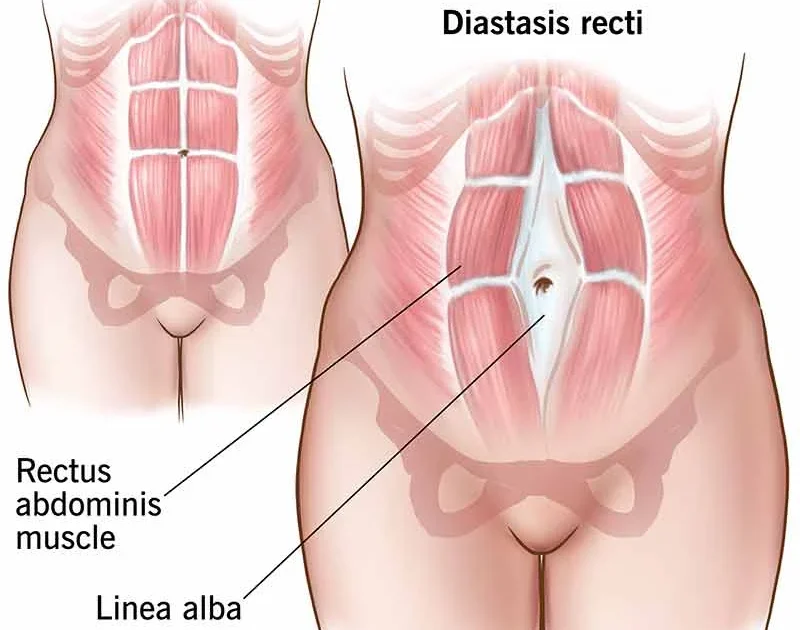
Diastasis recti is a condition involving separation or widening between the two sides of the rectus abdominis muscles along the midline of the abdomen. The connective tissue running between these muscles is called the linea alba.
The rectus abdominis muscles are the paired muscles located at the front of your abdomen. They contribute to trunk movement and work together with other muscles of the abdominal wall to help manage movement and forces through the torso.
The linea alba is not simply an empty space between the muscles. It is connective tissue formed from the aponeuroses of several abdominal muscles and plays an important role in the mechanical function of the abdominal wall. When the abdominal wall changes, the relationship between the rectus muscles and the linea alba can also change.
This is why the term abdominal muscle separation can sometimes be misleading. Diastasis recti is not simply a case of two muscles “moving apart.” It involves changes to the abdominal wall and its connective tissue, and the clinical significance of those changes varies from one person to another.
How Does Diastasis Recti Develop?
Pregnancy is one of the most commonly discussed situations associated with diastasis recti after pregnancy. As the abdomen expands during pregnancy, the abdominal wall adapts to accommodate changes in body shape and internal pressure. The rectus abdominis muscles may become further separated along the midline, while the linea alba undergoes stretching and other mechanical changes.
After childbirth, the abdominal wall may gradually adapt again, but recovery does not happen in exactly the same way or at the same pace for everyone.
Some people may notice a visible change in the shape of their abdomen, while others may be more concerned about core weakness, movement control, or returning to exercise. The European Hernia Society describes rectus diastasis in relation to separation between the rectus muscles and notes that core instability and impaired body image can be important symptoms.
Importantly, diastasis recti is not only a postpartum condition. It can also be present in people who have never been pregnant, including men. This is one reason it is better to consider the individual’s abdominal wall function and circumstances rather than assuming the cause based only on appearance.
Understanding Inter-Recti Distance
If you research diastasis recti assessment, you will probably come across the term inter-recti distance, commonly abbreviated as IRD.
Inter-recti distance refers to the distance between the medial borders of the two rectus abdominis muscles. Healthcare professionals may assess this distance as part of an examination, using methods such as palpation, calipers, or ultrasound depending on the clinical situation.
The European Hernia Society guidelines proposed a definition of rectus diastasis based on a separation greater than 2 cm. However, measurement methods, locations, and clinical interpretation can vary, and the measurement should not be viewed in isolation.
This point is particularly important for anyone searching for diastasis recti physical therapy.
A number on its own does not tell the complete story.
For example, two people could have a similar inter-recti distance but completely different experiences. One person might have little concern and continue normal activities, while another may feel that their abdominal wall lacks support or may have difficulty returning to certain exercises.
For this reason, a diastasis recti physiotherapy assessment may consider more than just the distance between the muscles. A clinician may also look at movement, breathing, abdominal wall control, symptoms, functional limitations, and the person’s individual goals.
Does a Larger Gap Always Mean a More Serious Problem?
Not necessarily.
The relationship between the measured separation and symptoms or functional limitations is not straightforward. Research and clinical guidelines have highlighted limitations in the evidence and variation in how diastasis recti is measured and classified.
This means that the goal of rehabilitation should not automatically be reduced to “closing the gap.”
For some people, the more meaningful goal may be improving core stability, developing better movement control, returning to exercise, or feeling more confident with everyday activities.
That distinction becomes important when discussing diastasis recti rehabilitation therapy. Successful rehabilitation should be considered in the context of the individual’s goals and function, not just one measurement.
Is Diastasis Recti the Same as a Hernia?
No. Diastasis recti and an abdominal hernia are different conditions, although they can sometimes occur together.
With diastasis recti, the concern involves separation or widening between the rectus abdominis muscles along the linea alba. A hernia involves tissue protruding through a defect or weakness in the abdominal wall. The two conditions therefore have different characteristics and may require different management.
This distinction matters because people sometimes notice an abdominal bulge and immediately assume they have diastasis recti.
A visible bulge does not automatically confirm the diagnosis.
If you develop a new or unusual abdominal bulge, particularly if it is painful, firm, increasingly prominent, or associated with other concerning symptoms, it is important to seek appropriate medical assessment rather than attempting to diagnose the problem yourself.
For people looking for physiotherapy for abdominal separation, this is an important part of setting realistic expectations. Physiotherapy can be considered for appropriate cases of rectus diastasis, but it does not replace medical evaluation when another abdominal condition, including a possible hernia, needs to be ruled out.
Can Diastasis Recti Affect Core Function?
The abdominal wall has an important role in movement and trunk control, so diastasis recti is not only an issue of abdominal appearance.
Your abdominal muscles work with other muscles around the trunk and pelvis to control movement and manage physical demands. Changes in abdominal wall structure may be associated with functional concerns in some people, but not everyone with diastasis recti experiences weakness, pain, or movement problems.
Some individuals may notice:
- A feeling of reduced abdominal support.
- Difficulty controlling certain movements.
- A visible ridge or bulge during specific activities.
- Reduced confidence when exercising.
- Difficulty returning to previous fitness activities.
- Concerns about abdominal strength after pregnancy.
- Other pelvic or musculoskeletal symptoms that may require separate assessment.
These experiences are highly individual.
For this reason, core rehabilitation for diastasis recti should not automatically mean performing as many abdominal exercises as possible. The focus is generally on understanding how the person moves and then progressing exercise according to their needs and tolerance.
Current research also supports taking a cautious approach to claims about specific exercises. A 2024 scoping review found that studies have investigated deep and superficial abdominal muscles, pelvic floor exercises, respiratory techniques, and functional exercises, but the studies varied considerably in their diagnostic methods and exercise programs.
More recent reviews have also produced differing conclusions about how much exercise changes inter-recti distance, which reinforces the importance of avoiding promises about guaranteed anatomical correction. Some evidence suggests exercise can reduce the measured separation, while other reviews conclude that the effect may be small or uncertain and that functional benefits should also be considered.
In practical terms, the question should not only be:
“How quickly can I close the gap?”
It should also be:
“How can I improve my abdominal wall function and safely return to the activities that matter to me?”
That is a much more useful starting point for individualized rehabilitation.
Diastasis Recti Causes, Risk Factors & Common Symptoms
What Causes Diastasis Recti?
There is no single cause of diastasis recti. Instead, it can develop when the abdominal wall is exposed to physical and mechanical changes that affect the relationship between the abdominal muscles and connective tissue.
Pregnancy is one of the most common situations in which abdominal separation is noticed. As the abdomen expands, the abdominal wall has to adapt to a changing body shape and increasing internal demands.
However, it is important not to think of diastasis recti simply as a problem caused by “weak abs.”
The abdominal wall consists of muscles, connective tissue, and other structures that work together. Changes in the linea alba and abdominal wall mechanics can contribute to the appearance and function associated with rectus abdominis diastasis.
Other factors may also be relevant, including repeated or increased abdominal loading and individual differences in anatomy and tissue characteristics. However, a particular exercise, lifting activity, or movement should not automatically be labeled as the cause of someone’s diastasis recti.
The exact presentation can vary considerably from person to person.
Why Is Diastasis Recti Common After Pregnancy?
Diastasis recti after pregnancy is a common concern, particularly among people who notice changes in their abdominal shape or core function following childbirth.
During pregnancy, the abdominal wall gradually stretches as the uterus grows. The rectus abdominis muscles can become more separated along the midline, and the linea alba adapts to the changing mechanical demands placed on the abdominal wall.
After childbirth, the body begins another period of physical adaptation. However, the abdominal wall does not necessarily return immediately to its previous appearance or function.
Some women may notice a midline bulge, reduced abdominal support, or difficulty returning to particular exercises. Others may have little or no functional concern despite having measurable abdominal separation.
This is why postpartum diastasis recti should be approached on an individual basis.
A 2024 review of postpartum diastasis recti rehabilitation found that studies have investigated a range of exercise approaches, including abdominal muscle training, pelvic floor muscle training, respiratory techniques, and functional exercises. However, the researchers also noted substantial variation between studies and insufficient evidence to establish one universally effective exercise program.
The takeaway is simple: postpartum recovery is not a competition against the clock.
Your body may need a gradual and appropriate return to movement rather than an aggressive attempt to strengthen the abdomen as quickly as possible.
Who Is More Likely to Experience Diastasis Recti?
Although pregnancy and the postpartum period are strongly associated with diastasis recti, the condition is not limited to women who have given birth.
Factors that may be associated with an increased likelihood of abdominal separation or changes in abdominal wall function can include:
- Pregnancy-related changes.
- Multiple pregnancies.
- Significant changes in abdominal size.
- Increased or repeated abdominal loading.
- Individual anatomical differences.
- Differences in connective-tissue characteristics.
- Changes associated with aging.
- Other factors affecting abdominal wall structure and function.
These are risk factors or associations, not guarantees.
Having one of these factors does not mean someone will develop diastasis recti, and not having them does not necessarily mean the condition cannot occur.
That is why a proper diastasis recti assessment is more useful than trying to determine the condition based on risk factors alone.
Common Symptoms of Diastasis Recti
The symptoms of diastasis recti can be different from one person to another.
Some people mainly notice a change in abdominal appearance. Others may experience a feeling of weakness or reduced abdominal support during certain activities. Some may have no noticeable symptoms at all.
1. A Midline Abdominal Bulge
One of the most recognizable signs is a ridge or bulge along the center of the abdomen.
You may notice it when:
- Getting out of bed.
- Sitting up from a lying position.
- Performing certain abdominal movements.
- Coughing or straining.
- Lifting an object.
- Changing position.
This is sometimes described as a diastasis recti belly bulge.
However, a visible bulge does not automatically confirm diastasis recti. Other abdominal conditions can also produce a bulge, so clinical assessment may be appropriate if you are unsure about its cause.
2. Abdominal Doming or Coning
You may also hear the terms abdominal doming or coning.
These terms generally describe a visible change in the contour of the abdominal wall during particular movements or increases in abdominal pressure.
Seeing doming or coning can provide useful information during a physical assessment, but it should not be treated as a stand-alone diagnostic test.
The way the abdominal wall behaves during movement can be more informative when considered alongside the person’s symptoms, physical examination, and functional goals.
3. A Feeling of Core Weakness
Some people with abdominal separation describe a feeling that their core is not providing the same level of support as before.
You might notice:
- Difficulty controlling certain movements.
- Reduced confidence when exercising.
- Difficulty with particular core exercises.
- A feeling of abdominal weakness.
- Difficulty returning to previous physical activities.
This is sometimes described as core muscle weakness or abdominal wall weakness.
However, not everyone with diastasis recti has weakness. The presence of abdominal separation does not automatically mean the abdominal muscles are incapable of functioning properly.
4. Difficulty With Certain Movements
Another concern can be difficulty with specific functional activities.
For example, a person may feel uncomfortable or uncertain when:
- Getting up from the floor.
- Moving from lying to sitting.
- Lifting or carrying.
- Performing certain gym exercises.
- Returning to sport.
- Managing physically demanding daily activities.
These difficulties may have multiple causes, so they should not automatically be attributed to diastasis recti.
A physiotherapist can assess movement patterns and determine whether abdominal wall rehabilitation may be relevant.
Can You Have Diastasis Recti Without Pain?
Yes.
Diastasis recti does not necessarily cause pain.
Some people primarily notice an abdominal shape change without experiencing discomfort. Others may have concerns about weakness, movement, exercise, or abdominal support.
At the same time, if someone has abdominal pain, it should not automatically be assumed that diastasis recti is responsible.
Pain can have many possible causes, and a proper assessment is important when symptoms are persistent, severe, unusual, or interfering with daily life.
This is an important distinction when discussing diastasis recti symptoms:
You can have diastasis recti without pain, and abdominal pain does not automatically mean that diastasis recti is the cause.
The goal of assessment is therefore not simply to find a gap between the abdominal muscles. It is to understand the person’s overall presentation.
When Should You Consider a Diastasis Recti Assessment?
You may want to consider speaking with a qualified physiotherapist if you:
- Notice persistent abdominal separation after pregnancy.
- See a recurring midline abdominal bulge during movement.
- Feel that your core has become weaker.
- Are unsure whether you have diastasis recti.
- Want guidance before beginning abdominal strengthening exercises.
- Have difficulty returning to exercise after childbirth.
- Feel uncertain about how to safely progress your workouts.
- Have ongoing concerns about abdominal wall function.
If you are wondering, “When should I see a physiotherapist for diastasis recti?”, the answer depends on your symptoms, goals, and concerns. You do not necessarily need to wait until the problem becomes severe before asking for professional guidance.
A physiotherapist for diastasis recti can assess your individual presentation and help determine whether physiotherapy is appropriate.
A diastasis recti physiotherapy assessment may look at more than the abdominal gap. Depending on the situation, it may consider movement, abdominal wall function, breathing coordination, symptoms, strength, exercise tolerance, and other relevant physical factors.
Final Thoughts
Diastasis recti is more than a cosmetic concern about the appearance of the stomach. It involves the abdominal wall and connective tissue, and its presentation can differ significantly between individuals.
Pregnancy is a common setting in which abdominal muscle separation becomes noticeable, but diastasis recti is not exclusively a postpartum condition. Some people may experience a visible abdominal bulge or doming, while others may mainly notice changes in core function or exercise confidence. Some may have no significant symptoms at all.
Most importantly, the size of the separation alone does not tell the entire story. A person’s symptoms, movement, abdominal wall function, and rehabilitation goals should also be considered. Current evidence on exercise-based treatment continues to evolve, with systematic reviews reporting variability in study methods and uncertainty about the magnitude of anatomical changes achievable through conservative treatment.
3. How Does Diastasis Recti Physiotherapy Work?
After learning what diastasis recti is and recognizing its possible signs, the next question is usually straightforward: What actually happens during diastasis recti physiotherapy?
The answer is not simply “do abdominal exercises.” Effective rehabilitation starts with understanding the individual’s condition, symptoms, movement patterns, current physical capacity, and goals. A physiotherapist can use this information to develop an appropriate diastasis recti treatment plan rather than giving every patient the same exercise routine.
Step 1: Diastasis Recti Physiotherapy Assessment
A diastasis recti physiotherapy assessment is generally the starting point before progressing into a structured rehabilitation program.
During an assessment, a physiotherapist may ask about your medical history, pregnancy or postpartum recovery when relevant, symptoms, physical activities, and the movements that are currently difficult or uncomfortable.
The assessment may also consider:
- Abdominal wall function
- Core muscle control
- Breathing patterns
- Movement coordination
- Exercise tolerance
- Functional limitations
- Abdominal muscle separation
- Inter-recti distance where appropriate
- Pelvic floor concerns when relevant
- Your personal rehabilitation goals
The purpose is not simply to determine whether there is a gap between the abdominal muscles. The physiotherapist also wants to understand how the abdominal wall functions during movement.
For example, someone may be concerned about a visible abdominal bulge but have no meaningful difficulty with everyday activities. Another person may have a similar finding but struggle with exercise, lifting, or postpartum movement. Their rehabilitation needs may therefore be very different.
Understanding Inter-Recti Distance During Assessment
Inter-recti distance, or IRD, is one measurement that may be considered when assessing diastasis recti. It describes the distance between the medial edges of the rectus abdominis muscles.
However, the measurement should be interpreted alongside the person’s symptoms and functional presentation rather than treated as the only indicator of progress or severity.
This is particularly important because different assessment techniques and measurement locations can produce different results. Clinical guidelines and research also recognize limitations in the evidence surrounding the definition and measurement of rectus diastasis.
Step 2: Creating a Personalized Diastasis Recti Treatment Plan
Once the assessment is complete, the next step is developing a personalized core rehabilitation program.
Your treatment plan may depend on factors such as:
- Your current strength and fitness level
- The presence or absence of symptoms
- Your postpartum recovery stage, if applicable
- Your daily physical demands
- Previous exercise experience
- Your movement patterns
- Your rehabilitation goals
- How your body responds to exercise
Someone who is returning to exercise after childbirth may need a different program from someone who wants to improve their ability to perform physically demanding work.
This is why diastasis recti rehabilitation therapy should be progressive and individualized.
Rather than immediately performing difficult abdominal exercises, rehabilitation may begin with basic movement control and gradually introduce greater physical demands as appropriate.
The goal is to build capacity over time.
Step 3: Breathing and Core Coordination
Breathing is an important part of how the trunk manages pressure during movement. For this reason, a physiotherapist may assess how you breathe and coordinate your abdominal muscles during different activities.
Breathing and core coordination may involve learning how to:
- Breathe without excessive abdominal bracing.
- Coordinate breathing with movement.
- Develop awareness of abdominal muscle activity.
- Manage physical effort during exercise.
- Progress toward more demanding movements.
This does not mean that breathing exercises alone “fix” diastasis recti. Instead, breathing may form one component of a broader rehabilitation program.
For some people, improving coordination can make it easier to progress toward strengthening and functional exercises.
Step 4: Progressive Core Rehabilitation
Once basic movement and coordination are established, a physiotherapist may introduce appropriate deep core exercises and other strengthening activities.
Depending on the individual’s assessment, rehabilitation may involve exercises targeting:
- Transversus abdominis
- Rectus abdominis
- Internal and external oblique muscles
- Pelvic floor muscles when indicated
- Trunk stabilizing muscles
- Functional movement patterns
The important word here is progressive.
An exercise that is appropriate at one stage of recovery may not be suitable at another stage, and an exercise that is easy for one person may be too challenging for another.
Research has examined different forms of abdominal and core exercise for diastasis recti, but evidence remains heterogeneous. A review of postpartum rehabilitation studies found substantial differences in diagnostic criteria, exercise protocols, and outcome measures, making it difficult to identify one universally superior exercise program.
Therefore, diastasis recti physical therapy should focus on appropriate progression rather than chasing a single “magic exercise.”
Step 5: Functional Movement Training
The purpose of physiotherapy is not simply to make you better at performing exercises inside a clinic.
Ultimately, you need to use your body in real life.
That may mean:
- Getting out of bed
- Standing from the floor
- Lifting your child
- Carrying groceries
- Returning to gym workouts
- Performing household activities
- Returning to running or sport
- Managing physically demanding work
This is where functional movement rehabilitation becomes important.
A physiotherapist may gradually introduce movements that resemble the activities you want to return to. The exercises can then become more challenging as your strength, control, and tolerance improve.
For a postpartum patient, for example, rehabilitation may eventually progress from basic core control toward lifting, carrying, resistance training, or other activities relevant to everyday life.
4. 7 Diastasis Recti Physiotherapy Exercises to Support Core Rehabilitation
Exercise is often the first thing people search for after learning about abdominal separation. However, the safest approach is not to assume that every person needs the same seven exercises.
The following movements represent types of exercises that may be incorporated into a diastasis recti rehabilitation program, depending on the individual’s assessment and ability.
1. Diaphragmatic Breathing and Abdominal Coordination
Controlled breathing can help develop awareness of how the diaphragm, abdominal wall, and trunk work together.
A physiotherapist may teach breathing exercises that encourage relaxed, controlled breathing while maintaining appropriate abdominal coordination.
Relevant keywords:
- Abdominal breathing exercises
- Breathing and core coordination
- Deep core exercises
The emphasis should be on control rather than forceful abdominal bracing.
2. Transversus Abdominis Activation
The transversus abdominis is one of the muscles contributing to abdominal wall function.
A physiotherapist may introduce gentle activation exercises to help a patient develop awareness and control of this muscle.
The objective is not to constantly “pull the stomach in.” Instead, the exercise should be performed with appropriate breathing and movement control.
Related keywords:
- Transversus abdominis exercises
- Deep core exercises
- Abdominal muscle strengthening
3. Pelvic Floor and Core Coordination
The pelvic floor and abdominal muscles are part of a larger system involved in trunk and pelvic function.
Where clinically appropriate, pelvic floor exercises for diastasis recti may be incorporated into rehabilitation.
This can involve learning how to coordinate pelvic floor activity with breathing and abdominal movement rather than treating the pelvic floor and abdominal wall as completely separate systems.
Related keywords:
- Pelvic health physiotherapy
- Pelvic floor and abdominal muscle coordination
- Postpartum core rehabilitation
Not everyone with diastasis recti requires pelvic floor rehabilitation, so assessment remains important.
4. Controlled Pelvic Tilts and Basic Trunk Control
Simple controlled movements can be used to develop awareness of pelvic position and trunk control.
Depending on the individual, exercises such as pelvic tilts may form part of an early rehabilitation program.
The focus should be on:
- Smooth movement
- Controlled breathing
- Comfortable range of motion
- Appropriate abdominal coordination
These are examples of gentle abdominal exercises, not a mandatory routine for everyone.
5. Core Stability Exercises
As control improves, rehabilitation may progress toward core stability exercises that challenge the trunk in a controlled manner.
The exact exercise will depend on the person’s strength and goals.
A physiotherapist may gradually increase:
- Movement complexity
- Resistance
- Repetitions
- Duration
- Functional demands
The objective is to build capacity without unnecessarily overwhelming the person’s current ability.
6. Progressive Abdominal Strengthening
Once a person can perform appropriate foundational exercises with good control, more demanding abdominal muscle strengthening may be introduced.
This could include progressively challenging trunk exercises selected according to the individual’s goals.
The important point is that having diastasis recti does not automatically mean that someone must avoid all challenging abdominal exercises forever.
Instead, exercise selection and progression should be individualized.
7. Functional Movement and Return-to-Exercise Training
Eventually, rehabilitation may need to move beyond isolated abdominal exercises.
A person who wants to return to the gym, running, sports, or physically demanding activities may need a gradual transition toward those activities.
This is where diastasis recti exercise progression becomes especially useful.
The rehabilitation process may move from:
Basic control → Strength → Functional movement → Higher physical demands → Return to desired activity
The exact progression depends on the individual’s symptoms, capacity, goals, and clinical assessment.
Are These Exercises Suitable for Everyone With Diastasis Recti?
Not necessarily.
There is no universal list of exercises that is automatically appropriate for every person with abdominal separation. A movement may be suitable for one person but require modification for another.
Exercise selection can depend on:
- Current strength
- Symptoms
- Technique
- Postpartum recovery
- Previous exercise experience
- Other musculoskeletal conditions
- Pelvic floor concerns
- Individual rehabilitation goals
This is why a physiotherapist for diastasis recti can be valuable when you are unsure where to begin.
Rather than asking only, “Which exercise closes the gap?”, a more useful question is:
“Which exercises are appropriate for my current condition, and how should I progress them?”
That approach makes rehabilitation more practical and individualized.
What About Crunches, Planks and Other Abdominal Exercises?
You may find advice online claiming that people with diastasis recti should completely avoid crunches, planks, or other demanding abdominal exercises.
The reality is more nuanced.
Exercise suitability depends on the individual, the movement being performed, the person’s current capacity, technique, symptoms, and rehabilitation stage. Blanket rules that every person with diastasis recti must permanently avoid particular exercises are not supported by a simple one-size-fits-all approach.
Instead, exercises may be modified, regressed, or progressed according to the individual’s response and goals.
A qualified physiotherapist can help determine how to safely develop core stability and abdominal strength without unnecessarily restricting physical activity.
Key Takeaway
Diastasis recti physiotherapy is not simply about performing more abdominal exercises. It starts with assessment, followed by an individualized rehabilitation plan that may include breathing and core coordination, progressive strengthening, pelvic floor training when appropriate, and functional movement.
The next important question is what a complete diastasis recti physiotherapy treatment plan may look like and how progress can be monitored over time.
- Clinic Name: Aspire Wellness
- Address: DHA Phase 2 Ext Karachi
- Phone Number: 03095885076
- Website: https://aspirewellness.pk
- Google Maps URL: https://maps.app.goo.gl/QF5LJZUkJTRgnR2TA
- Products: https://aspirewellness.pk/shop/