

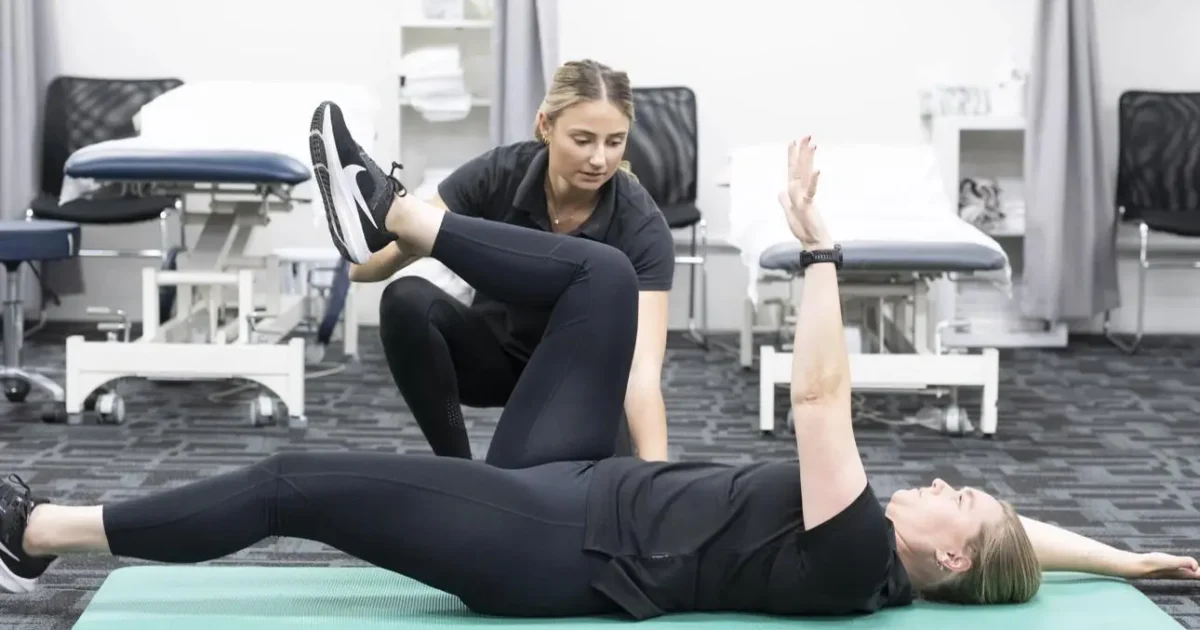
Many people believe that Clinical Pilates is simply a gentler version of regular Pilates or a type of exercise meant only for people recovering from injuries. That is not quite the full picture. Clinical Pilates is an individualized exercise approach that can be adapted to a person’s movement abilities, physical goals, and rehabilitation needs. While it can be used during recovery, it may also be incorporated into exercise programs focused on strength, mobility, balance, movement control, and physical function.
If you experience back discomfort, reduced mobility, muscle weakness, poor postural awareness, or difficulty performing certain movements, you may have wondered whether Clinical Pilates is right for you.
Unlike following the same Pilates routine as everyone else, a physiotherapy-based approach can be adjusted according to your individual needs. Exercises may focus on core stability, muscle control, flexibility, balance, coordination, or functional movement.
So, what exactly is Clinical Pilates, how does it differ from regular Pilates, and what benefits can it offer?
Let’s take a closer look.
What Is Clinical Pilates and How Does It Work?
Clinical Pilates is an individualized form of Pilates-based exercise commonly used within physiotherapy and rehabilitation settings. Exercises can be selected and modified according to a person’s physical abilities, movement patterns, symptoms, and goals.
Traditional Pilates is generally associated with controlled movements, breathing, concentration, coordination, flexibility, and strength. Clinical Pilates uses many of these principles but applies them within a more individualized framework.
For example, imagine two people attending a Pilates session.
One person may simply want to improve general fitness and core strength. Another may be returning to exercise after an injury and have difficulty with particular movements. Although both may perform Pilates-based exercises, their programs do not necessarily need to be identical.
A physiotherapist may modify the exercises, resistance, range of movement, repetitions, positioning, or level of support according to the individual’s needs.
Research describing Pilates commonly identifies elements such as core stability, strength, flexibility, muscle control, posture, and breathing as part of the method.
Understanding Clinical Pilates
One of the biggest misconceptions about Clinical Pilates is that the exercises themselves must always be completely different from regular Pilates.
In reality, some exercises may look similar.
The difference is often found in why the exercise is being performed, how it is selected, and how it is adapted.
A physiotherapist may use a Pilates-based exercise to address a particular movement goal, such as:
- Improving trunk control
- Developing muscle strength
- Increasing movement confidence
- Supporting balance
- Improving mobility
- Building exercise tolerance
- Supporting rehabilitation
- Preparing for a return to normal activities
This individualized approach is one reason the term physiotherapy Pilates is often used when Pilates-based exercises are incorporated into physiotherapy care.
How Clinical Pilates Works in Rehabilitation
Clinical Pilates rehabilitation generally begins with understanding the person’s current condition and goals.
A physiotherapist may consider:
- Your symptoms and relevant medical history
- Current physical activity level
- Strength and endurance
- Mobility and range of movement
- Balance and coordination
- Functional limitations
- Previous injuries
- Exercise experience
- Personal rehabilitation goals
This information can help determine which exercises are appropriate and how they should be progressed.
For example, a person recovering from an injury may initially require simple, supported movements. As strength and confidence improve, the exercises can potentially become more challenging.
Progression does not necessarily mean simply doing more repetitions. It could involve changing resistance, movement range, exercise complexity, stability demands, or functional requirements.
What Are the Main Goals of Clinical Pilates?
There is no single goal that applies to every Clinical Pilates participant.
Some people may want to improve general movement and strength, while others may have specific rehabilitation goals.
Common areas of focus include:
Core strength and stability: Developing better control of the trunk during movement.
Postural awareness: Understanding how the body moves and changes position during different activities.
Flexibility and mobility: Working through appropriate ranges of movement.
Balance and coordination: Practicing controlled movement and stability.
Functional rehabilitation: Connecting exercise with meaningful daily or activity-related goals.
These areas often overlap. Improving strength, for example, may also contribute to better movement control during everyday activities.
What Is the Role of a Physiotherapist?
A physiotherapist can help determine whether Clinical Pilates physiotherapy is appropriate for a person’s needs and how exercises should be adapted.
Rather than simply demonstrating an exercise, the clinician may assess movement, provide feedback, modify technique, and adjust the program as the person progresses.
This can be particularly relevant for people who:
- Are recovering from an injury
- Have difficulty with certain movements
- Want an individualized exercise program
- Have specific rehabilitation goals
- Need help progressing their exercises
- Are uncertain about which exercises are appropriate
Clinical Pilates should not be viewed as a replacement for medical assessment when symptoms require further investigation. Instead, it can be one component of an appropriate physiotherapy or rehabilitation program.
Clinical Pilates vs Regular Pilates: What Is the Difference?
Clinical Pilates and regular Pilates share several principles. Both can involve controlled movement, coordination, strength, flexibility, breathing, and body awareness.
The main difference is generally the context and level of individualization.
Clinical Pilates is often used in a physiotherapy or rehabilitation context, where exercises can be selected according to a person’s individual needs.
Regular Pilates is commonly performed for general fitness, conditioning, movement, and exercise.
However, the distinction is not absolute. Pilates instructors can also provide individualized programs, while physiotherapists may use Pilates-based exercises for general fitness or conditioning.
Clinical Pilates vs Regular Pilates: A Simple Comparison
| Feature | Clinical Pilates | Regular Pilates |
|---|---|---|
| Main focus | Individualized exercise and rehabilitation-related goals | General fitness, conditioning, and movement |
| Exercise selection | Adapted to individual needs | Often follows a general class or routine |
| Assessment | May include a physiotherapy assessment | Depends on the instructor and setting |
| Progression | Adjusted according to individual response | Often follows class or program progression |
| Professional involvement | May be provided by a physiotherapist or appropriately trained clinician | Usually provided by a Pilates instructor |
| Typical goals | Rehabilitation, movement control, strength, mobility, or individualized goals | Fitness, conditioning, flexibility, strength, and movement |
The exact service can vary between providers, so it is sensible to ask about the professional’s qualifications and how the program is structured.
Why Does Individualization Matter?
Imagine joining a group where everyone is given exactly the same exercise routine.
That routine might be perfectly manageable for one person but unnecessarily difficult for another.
Someone recovering from an injury may need a modified movement. Someone who has been inactive for a long time may need a gradual introduction to exercise. An experienced participant may be ready for a greater challenge.
This is where an individualized exercise program can make a difference.
The objective is not to make every exercise easier. Instead, the exercise should be appropriately challenging for the individual.
A physiotherapist may modify:
- Starting position
- Range of movement
- Resistance
- Repetitions
- Exercise complexity
- Stability requirements
- Rest periods
- Equipment or support
The program can then evolve as the person’s ability changes.
Clinical Pilates vs Regular Pilates for Rehabilitation
People searching for Clinical Pilates vs regular Pilates for rehabilitation are often trying to understand which approach may be more suitable after an injury or when dealing with movement limitations.
Clinical Pilates may be considered when a person has specific rehabilitation goals and would benefit from individualized assessment and exercise guidance.
For example, someone returning to activity after an injury may need to rebuild strength and movement confidence gradually. A physiotherapist can consider the person’s current abilities and select exercises accordingly.
Regular Pilates may also provide valuable exercise and conditioning. However, someone with a specific injury or rehabilitation requirement should consider whether the instructor has the appropriate experience and whether the program can be adapted to their needs.
There is no universal exercise program that works identically for every person.
The better question is:
Does the exercise program match your current abilities, goals, and rehabilitation needs?
Benefits of Clinical Pilates
Clinical Pilates can be used for different purposes depending on the individual. Research on Pilates has examined outcomes including strength, function, flexibility, posture, balance, and pain-related outcomes.
However, it is important to avoid thinking of Clinical Pilates as a guaranteed treatment for every condition. Research studies use different Pilates programs, populations, durations, and exercise intensities, so results cannot automatically be applied to every individual.
With that in mind, here are seven potential benefits worth understanding.
1. Clinical Pilates Supports Core Strength and Stability
One of the most commonly associated areas of Pilates is core strength.
Your core is not simply your abdominal muscles. Trunk stability involves coordinated activity from multiple muscles around the abdomen, pelvis, back, and hips.
Clinical Pilates exercises can incorporate controlled movements that challenge trunk stability and coordination.
How Does Clinical Pilates Help Core Strength?
Exercises may require you to maintain control of your trunk while moving your arms or legs.
For example, a physiotherapist might introduce:
- Pelvic control exercises
- Bridge variations
- Modified dead-bug movements
- Controlled trunk exercises
- Supine abdominal control exercises
The exact exercises depend on the person’s goals and abilities.
The objective is not simply to “tighten your abs.” Good movement control involves coordination between different parts of the body.
Why Is Core Stability Important?
Adequate trunk control can contribute to everyday movements such as:
- Getting up from a chair
- Bending
- Lifting
- Walking
- Climbing stairs
- Exercising
- Participating in sports
Clinical Pilates can therefore be used as part of a broader exercise program aimed at developing core stability exercises and functional strength.
Recent research also supports the broader role of core exercise in chronic nonspecific low back pain, although individual programs and outcomes vary.
2. Clinical Pilates May Help Improve Postural Awareness
Posture is another frequently discussed reason people become interested in Pilates.
However, posture is more complicated than simply trying to hold your back in one “perfect” position all day.
Your body naturally changes position while sitting, standing, walking, reaching, working, and exercising.
Instead of trying to maintain one rigid posture, Clinical Pilates may help people develop better awareness and control of different positions and movements.
Clinical Pilates for Posture Correction
Exercises may focus on:
- Trunk control
- Pelvic movement
- Spinal mobility
- Muscle endurance
- Shoulder and upper-body control
- Awareness of movement patterns
The phrase Pilates for posture correction is commonly used online, but it is more accurate to describe the goal as improving postural awareness, movement control, and physical capacity rather than promising to permanently “correct” someone’s posture.
Clinical Pilates for Office Workers
People who spend many hours sitting at a desk may become interested in Clinical Pilates for posture because prolonged sitting can be associated with stiffness, reduced movement variety, and discomfort.
A suitable exercise program can incorporate:
- Mobility exercises
- Strength exercises
- Movement breaks
- Trunk endurance exercises
- Hip and shoulder movement
- General physical activity
The goal should not be to stay perfectly upright for eight hours. Instead, regularly changing positions and maintaining adequate physical capacity can be more practical.
3. Clinical Pilates May Support Back Pain Management
Lower back pain is one of the areas most frequently associated with Pilates research.
A systematic review of Pilates literature found that Pilates has been studied in relation to low back pain and includes elements such as strength, core stability, flexibility, muscle control, posture, and breathing.
More recent research continues to examine Pilates for chronic nonspecific low back pain. A 2025 randomized trial published in Clinical Rehabilitation found improvements in several outcomes among adults receiving a specific Clinical Pilates program, compared with general Pilates and general exercise.
A 2026 systematic review and meta-analysis also reported pain and functional improvements from Pilates among women with chronic low back pain.
These findings are encouraging, but they do not mean that Clinical Pilates is a guaranteed solution for every type of back pain.
Clinical Pilates for Lower Back Pain
Back pain can have many contributing factors.
For some people, the problem may be associated with reduced physical capacity, movement sensitivity, inactivity, or other musculoskeletal factors. Others may have an underlying condition that requires specific medical evaluation.
A physiotherapy assessment can help determine what type of exercise is appropriate.
A Clinical Pilates program for someone with lower back pain may focus on:
- Gradual strengthening
- Trunk control
- Hip movement
- Functional movement
- Exercise confidence
- Mobility
- Progressive physical activity
Clinical Pilates for Chronic Back Pain and Mobility
If you have experienced back pain for months, it is understandable to become cautious about movement.
However, avoiding movement completely can make it harder to rebuild physical capacity.
A gradual and appropriately designed exercise program can help people become more comfortable with movement and work toward functional goals.
Research comparing different mind-body exercise approaches has found Pilates to be associated with meaningful short-term reductions in low back pain, although the evidence and outcomes vary between interventions and populations.
Clinical Pilates should therefore be viewed as one possible exercise-based approach, rather than a universal treatment for every back condition.
4. Clinical Pilates Can Support Flexibility and Mobility
Strength is only one part of good movement.
You also need enough mobility to perform everyday activities comfortably.
Clinical Pilates exercises for flexibility and balance can incorporate controlled movements through appropriate ranges of motion while also working on strength and coordination.
Pilates for Flexibility
Flexibility refers to the ability of muscles and joints to move through an appropriate range.
Clinical Pilates may include movements that encourage:
- Spinal mobility
- Hip movement
- Shoulder mobility
- Controlled stretching
- Functional movement
However, more flexibility is not automatically better.
The appropriate range depends on the person and the activity.
For example, a gymnast may require a very different range of movement from someone whose primary goal is comfortable walking and everyday activity.
Pilates for Mobility
Mobility involves more than simply stretching.
It also requires strength, coordination, control, and the ability to use available movement effectively.
This is why an individualized Pilates program may combine mobility exercises with strengthening and movement-control exercises.
Instead of simply trying to make a joint move further, the goal may be to help the person use their available movement effectively and confidently.
5. Clinical Pilates May Improve Balance and Movement Control
Balance becomes especially important when people experience reduced strength, poor coordination, inactivity, or age-related changes.
Pilates for balance and stability can involve exercises that challenge the body’s ability to maintain control while changing position or moving the limbs.
Why Balance Matters
Good balance contributes to everyday activities such as:
- Walking
- Standing
- Turning
- Climbing stairs
- Getting out of a chair
- Reaching
- Participating in recreational activities
Clinical Pilates may incorporate controlled movements that challenge balance according to a person’s ability.
For example, a beginner may perform an exercise with additional support, while a more experienced person may perform a more challenging variation.
Recent research has continued to examine Pilates and other exercise approaches for balance and postural control in older adults, although the certainty and applicability of comparative evidence remain areas of ongoing research.
Clinical Pilates for Muscle Control
Movement is not only about strength.
You also need to coordinate different muscles at the right time and in an appropriate way.
This is where movement control exercises can become useful.
A physiotherapist may use controlled Pilates movements to help a person practice coordination and develop confidence with specific movement patterns.
6. Clinical Pilates Can Be Used as Part of Injury Rehabilitation
Recovering from an injury does not always mean simply waiting until pain disappears.
Rehabilitation often involves gradually rebuilding strength, mobility, coordination, confidence, and tolerance for activity.
This is where Clinical Pilates rehabilitation may have a role.
Physiotherapist-Led Clinical Pilates for Injury Recovery
A physiotherapist may modify exercises according to:
- Type of injury
- Stage of recovery
- Current strength
- Mobility
- Functional requirements
- Symptoms during movement
- Rehabilitation goals
For example, someone returning to exercise after an injury may begin with simpler movements before progressing toward more demanding exercises.
The program can change as the person improves.
Clinical Pilates for Sports Injuries
Athletes and active individuals often need more than basic pain reduction.
They may need to regain:
- Strength
- Balance
- Coordination
- Movement control
- Exercise tolerance
- Sport-specific capacity
Clinical Pilates may be included as one component of a broader sports rehabilitation program.
It should not automatically replace sport-specific strength training, conditioning, skill practice, or other rehabilitation approaches when those are needed.
7. Clinical Pilates Encourages Functional Movement and Individualized Exercise
Perhaps one of the most useful aspects of Clinical Pilates is that exercise can be connected to a person’s real-life goals.
Instead of asking only, “How many exercises can you perform?” a physiotherapist can consider:
What do you actually want to be able to do?
Maybe you want to:
- Walk comfortably
- Return to the gym
- Sit and work more comfortably
- Climb stairs
- Return to sport
- Improve general physical strength
- Move with greater confidence
The exercise program can then be designed around relevant physical requirements.
What Is an Individualized Clinical Pilates Program?
An individualized program may involve:
- Understanding your goals.
- Assessing relevant physical abilities.
- Selecting suitable exercises.
- Teaching appropriate technique.
- Monitoring your response.
- Progressing exercises when appropriate.
This makes Clinical Pilates more than simply following a list of Pilates exercises.
The program becomes a structured form of exercise that can be adjusted according to the individual.
A qualitative systematic review of experiences from Pilates-trained physiotherapists and patients found that practitioners described Pilates as something that can be tailored to individual requirements, preferences, and needs.
Clinical Pilates Exercises: What Can Beginners Expect?
If you have never tried Pilates before, you might imagine that you need to be extremely flexible or physically fit before starting.
That is not necessarily the case.
Clinical Pilates for beginners can start with basic movements and gradually progress according to the person’s ability.
The exercises used will depend on the individual, but some Pilates-based movements commonly seen in exercise programs include pelvic tilts, bridges, modified dead-bug patterns, and side-lying leg movements.
Pelvic Tilts
Pelvic tilts are a relatively simple movement that can help someone practice awareness and control of pelvic movement.
They may be adapted depending on the person’s mobility and comfort.
Bridge Variations
A bridge involves lifting the pelvis while maintaining controlled movement through the hips and trunk.
It can be modified according to strength and ability.
Modified Dead-Bug Movements
Dead-bug variations can challenge coordination between the arms, legs, and trunk.
Beginners may start with a simpler version before progressing to more challenging variations.
Side-Lying Leg Movements
Side-lying exercises can be used to work on hip movement and strength.
Again, the exact variation and difficulty should depend on the individual’s goals and abilities.
Can You Do Clinical Pilates Exercises at Home?
You may see many searches for Clinical Pilates exercises for beginners at home.
Home exercises can be useful when they are appropriate for the individual and form part of a suitable exercise program.
However, an online exercise list cannot assess your movement quality, symptoms, medical history, or individual limitations.
If you have an injury, persistent pain, recent surgery, neurological symptoms, or another medical concern, it is sensible to seek appropriate professional guidance before starting a new exercise routine.
A physiotherapist can teach you suitable exercises and explain how they can be progressed or modified.
Who Can Benefit From Clinical Pilates?
Clinical Pilates may be appropriate for a range of people, depending on their goals and physical condition.
Clinical Pilates for Beginners
Beginners can use an individualized program to learn basic movement patterns and gradually develop strength and coordination.
You do not need to master advanced Pilates exercises before starting.
The starting point should match your current ability.
Clinical Pilates for People With Back Pain
People experiencing back pain may explore Pilates as an exercise-based approach.
However, not every type of back pain is the same.
If symptoms are persistent, severe, worsening, or associated with significant neurological symptoms, an appropriate medical or physiotherapy assessment should come first.
Clinical Pilates for Older Adults
Older adults may have goals related to strength, mobility, balance, and independence.
A suitable program can be adapted by changing exercise difficulty, support, resistance, and movement demands.
Balance exercises can be particularly relevant where appropriate.
Clinical Pilates After an Injury
People recovering from injury may benefit from a structured and progressive exercise program.
The exercises should reflect the injury, rehabilitation stage, physical capacity, and functional goals.
This is why physiotherapist-led Clinical Pilates for injury recovery can be useful in appropriate cases.
What Happens During a Clinical Pilates Session?
If you are considering Clinical Pilates for the first time, knowing what to expect can make the process easier.
1. Initial Assessment
Your physiotherapist may ask about:
- Your goals
- Current symptoms
- Relevant medical history
- Previous injuries
- Daily activities
- Exercise experience
A physical assessment may then be performed where appropriate.
2. Exercise Selection
The physiotherapist chooses exercises according to your needs.
You may start with basic movements and progress gradually.
3. Guided Practice
You receive instructions and feedback about technique, movement, breathing, and control.
The physiotherapist can modify the exercise if necessary.
4. Progression
As your ability changes, exercises may become more challenging.
Progression could involve:
- More repetitions
- Increased resistance
- Greater movement range
- More complex movements
- Less external support
- More functional activities
The appropriate progression depends on the individual.
Clinical Pilates for Common Rehabilitation Goals
Clinical Pilates can be incorporated into different rehabilitation programs when appropriate.
Lower Back Pain
Exercises may focus on strength, movement control, mobility, and gradual return to activity.
Postural Concerns
A program may focus on movement awareness, strength, endurance, and mobility rather than attempting to force the body into one “perfect” posture.
Knee Rehabilitation
Pilates-based exercises may be adapted to support lower-limb strength and functional movement when clinically appropriate.
Sports Recovery
Exercises may contribute to strength, coordination, balance, and movement control alongside other sports rehabilitation methods.
Older Adults
Exercise can be adapted to focus on strength, mobility, balance, and functional independence.
The important point is that Clinical Pilates should be individualized rather than treated as a universal exercise prescription.
How Often Should You Do Clinical Pilates?
There is no single number of Clinical Pilates sessions that is appropriate for everyone.
Frequency can depend on:
- Your goals
- Physical condition
- Exercise experience
- Rehabilitation stage
- Current activity level
- Response to exercise
- Whether you are also performing home exercises or other forms of physical activity
For some people, supervised sessions may be combined with an individualized home exercise program.
Consistency is generally more useful than simply trying to exercise as intensely as possible.
Research in chronic nonspecific low back pain has also found similar outcomes between high- and low-intensity Pilates in one randomized trial, with fewer adverse events reported in the low-intensity group.
This reinforces an important principle: more intense does not automatically mean better.
How Long Does It Take to See Results?
This is one of the most common questions people ask before starting an exercise program.
The honest answer is that there is no universal timeline.
Different people have different goals.
Someone focusing on general mobility may notice changes differently from someone recovering from an injury or managing chronic back pain.
Progress can be assessed through:
- Movement ability
- Strength
- Balance
- Exercise tolerance
- Functional activities
- Confidence with movement
- Changes in symptoms
Rather than focusing only on how quickly pain disappears, a broader view of functional progress can provide a more useful picture.
Is Clinical Pilates Right for You?
If you are considering Clinical Pilates, start by thinking about why you want to exercise.
Are you looking to:
- Improve strength?
- Develop core stability?
- Improve mobility?
- Work on balance?
- Become more active?
- Recover from an injury?
- Support a rehabilitation program?
- Improve movement confidence?
Your answer can help determine whether a general Pilates program or a more individualized physiotherapy-based approach is appropriate.
If you have persistent pain, an injury, significant movement limitations, or concerns about starting exercise, an assessment by an appropriate healthcare professional can help guide your next step.
Frequently Asked Questions About Clinical Pilates
What is Clinical Pilates?
Clinical Pilates is an individualized Pilates-based exercise approach that may be used within physiotherapy and rehabilitation. Exercises can be adapted according to a person’s physical abilities, goals, symptoms, and functional needs.
Is Clinical Pilates the same as regular Pilates?
No, not necessarily. They can use similar exercises and principles, but Clinical Pilates is commonly more individualized and may be delivered within a physiotherapy or rehabilitation setting.
Is Clinical Pilates good for lower back pain?
Pilates has been studied for chronic low back pain, and research has reported improvements in pain and function in various populations. However, outcomes differ between individuals, and Clinical Pilates is not appropriate as a universal treatment for every cause of back pain.
Can beginners do Clinical Pilates?
Yes. Clinical Pilates exercises can be modified for beginners. The program should start at an appropriate level and progress according to the individual’s ability and goals.
Can Clinical Pilates help improve posture?
Clinical Pilates may support postural awareness, muscle endurance, movement control, and physical capacity. It should not be viewed as a guaranteed way to permanently “correct” posture.
Can Clinical Pilates help after an injury?
It may be incorporated into rehabilitation when appropriate. Exercise selection should take into account the type of injury, stage of recovery, current ability, and functional goals.
Can I do Clinical Pilates at home?
Some exercises may be appropriate for a home program after they have been selected and taught appropriately. If you have pain, an injury, or specific medical concerns, professional guidance can help determine which exercises are suitable.
How often should I do Clinical Pilates?
There is no universal schedule. Frequency depends on your goals, physical condition, exercise program, and response to training. A physiotherapist can help establish an appropriate plan.
Why Choose Aspire Wellness for Clinical Pilates?
If you are looking for Clinical Pilates in DHA Karachi, choosing a provider should involve more than simply searching for a Pilates class.
Look for a service that understands your goals and can provide appropriate exercise guidance.
At Aspire Wellness, Clinical Pilates can be positioned within a physiotherapy-focused approach, where exercise selection can be connected to individual movement and rehabilitation goals.
A professional assessment can help determine which exercises are appropriate, how they should be modified, and how your program can progress over time.
Whether your goal is improving core strength, mobility, posture, balance, movement control, or rehabilitation, the focus should remain on creating an exercise approach that is appropriate for you.
For people searching for Clinical Pilates physiotherapy in Karachi, a consultation can be a useful first step to discuss your goals and determine whether a physiotherapy-led Pilates program is suitable.
Final Thoughts
Clinical Pilates is more than simply performing Pilates exercises. Its key strength is the ability to adapt exercise to the individual.
Depending on your goals, a program may focus on core stability, strength, mobility, flexibility, balance, coordination, posture-related concerns, or rehabilitation.
Research supports the use of Pilates across several areas, particularly low back pain and physical function, although the evidence varies according to the population and specific program being studied.
If you are a beginner, recovering from an injury, experiencing movement limitations, or simply looking for a more individualized exercise approach, Clinical Pilates may be worth discussing with a qualified physiotherapist.
The right exercise program is not necessarily the hardest one. It is the one that matches your current ability, goals, and needs—and progresses appropriately as you improve.
Aspire Wellness can help you explore physiotherapy and individualized exercise options if Clinical Pilates is part of the services currently offered by your clinic.
- Clinic Name: Aspire Wellness
- Address: DHA Phase 2 Ext Karachi
- Phone Number: 03095885076
- Website: https://aspirewellness.pk
- Google Maps URL: https://maps.app.goo.gl/QF5LJZUkJTRgnR2TA
- Products: https://aspirewellness.pk/shop/