

Introduction
What Does Functional Electrical Stimulation Do?
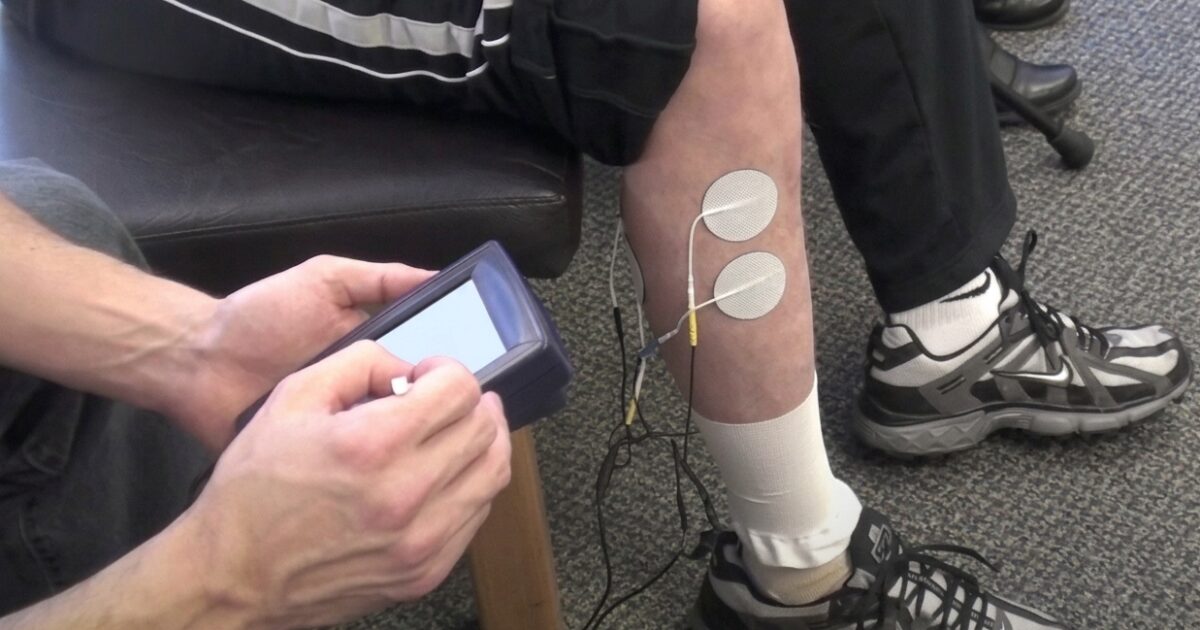
Functional electrical stimulation, or FES, works by applying small electrical pulses to a peripheral nerve or muscle to produce certain movements.
To treat foot drop following stroke, stimulation is typically applied to the common peroneal nerve to activate dorsiflexion and eversion muscles of the ankle.
During normal walking (gait), dorsiflexion is necessary during the “swing” phase of stepping to lift the foot and prevent the toes from dragging on the ground as the leg moves forward. After stroke, weakness or poor neuromuscular control can cause inadequate dorsiflexion of the ankle, leading to toe dragging or compensatory movements, such as excessive hip or knee flexion, as the patient attempts to lift their foot during walking.
FES attempts to restore this motion by providing timed assistance with ankle dorsiflexion while walking.
Why Does Foot Drop Occur After Stroke?
-
Ankle Dorsiflexor Weakness: Inability to lift the front part of the foot.
-
Impaired Selective Motor Control: Difficulty moving specific joints independently.
-
Spasticity & Abnormal Muscle Tone: Involuntary muscle tightness or stiffness.
-
Sensory Deficits & Reduced Proprioception: Loss of body awareness, making it hard to feel where the foot is in space.
-
Poor Coordination & Altered Gait Mechanics: Changes in walking patterns to compensate for weakness.
How Functional Electrical Stimulation (FES) Helps Restore Gait
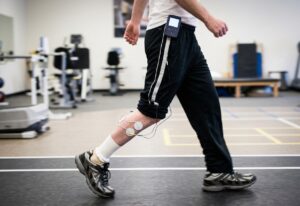
Key benefits of incorporating FES into neuro-rehabilitation include:
-
Functional Movement Retraining: Rather than isolated muscle flexes, patients practice real-world walking patterns.
-
Neuromuscular Re-education: Repetitive, task-specific movement helps encourage neuroplasticity and motor recovery.
-
Customized Treatment: Parameters such as electrode placement, signal intensity, pulse duration, and timing are tailored to each individual’s gait mechanics and comfort.
What Clinical Research Reveals About FES Therapy
Clinical Considerations & Limitations
-
Stroke Severity & Location: The extent of initial neural tissue damage.
-
Time Since Stroke: Chronic vs. acute rehabilitation phases.
-
Baseline Motor Function & Comorbidities: Existing mobility levels and general health.
-
Therapy Intensity & Patient Response: Frequency of rehabilitation sessions and individual neural adaptability.
Key Benefits of FES for Post-Stroke Recovery
Functional Electrical Stimulation (FES) offers distinct clinical advantages for stroke survivors regaining mobility:
-
Faster Walking Speed: Clinical meta-analyses demonstrate that combining peroneal nerve FES with physical therapy significantly improves gait velocity compared to standard care alone.
-
Better Foot Clearance & Toe Lift: By actively triggering dorsiflexion during the swing phase, FES helps clear the ground, reducing tripping hazards and eliminating unnatural movement compensations (such as hip circumduction).
-
Task-Specific Neural Practice: Unlike static exercises, FES stimulates muscles directly during walking, reinforcing functional motor patterns.
-
Seamless Therapy Integration: FES fits into broader neuro-rehabilitation programs alongside balance training, strength work, and mobility exercises.
FES vs. Ankle-Foot Orthosis (AFO): How They Compare
Both interventions address stroke-related foot drop, but they work through entirely different mechanisms:
| Feature / Consideration | Functional Electrical Stimulation (FES) | Ankle-Foot Orthosis (AFO) |
| Primary Mechanism | Active electrical stimulation of the peroneal nerve | Passive mechanical support stabilizing the ankle joint |
| Neuromuscular Engagement | Actively contracts muscles to promote neuroplasticity | Holds the foot in a fixed position without muscle activation |
| Flexibility & Movement | Allows natural joint movement throughout the gait cycle | Limits ankle mobility to maintain structural alignment |
| Key Clinical Factors | Requires intact peripheral nerves and patient tolerance | Best for severe spasticity, joint instability, or fixed contractures |
Choosing between FES and an AFO depends on factors like spasticity level, residual motor control, sensory function, joint mobility, and personal preference. Some rehabilitation plans even combine both at different stages of recovery.
What to Expect During FES Treatment
Before starting FES therapy, a physical therapist or rehabilitation specialist conducts a complete clinical evaluation to assess muscle tone, range of motion, and gait mechanics.
-
Target Identification: Locating the optimal stimulation point over the peroneal nerve.
-
Electrode Placement & Calibration: Position pads and set pulse intensity, frequency, and signal timing for maximum comfort and muscle contraction.
-
Gait Synchronization: Pairing the device’s heel sensor with the patient’s step rhythm.
-
Active Practice & Adjustment: Practicing real-time walking while fine-tuning settings based on fatigue, gait quality, and progress.
Safety, Candidacy, and Limitations
While FES is safe and widely used in neurological rehabilitation, it is not suitable for everyone.
-
Is FES Safe? Yes, though some individuals experience mild skin irritation under the electrode pads or find the electrical tingling uncomfortable. Proper setup by a clinician ensures safety and comfort.
-
Can FES Replace Physical Therapy? No. FES is an adjunct tool—it works best alongside traditional therapy addressing core strength, endurance, balance, and flexibility.
-
Who Benefits Most? Candidates must have intact peripheral nerve pathways capable of responding to electrical signals. Severe spasticity, joint contractures, or profound sensory loss may limit its effectiveness.
Frequently Asked Questions
Does electrical stimulation help post-stroke foot drop?
Yes. Research shows that peroneal nerve FES combined with exercise therapy improves both gait speed and overall foot clearance in eligible stroke survivors.
Is FES better than a traditional leg brace (AFO)?
Neither is universally superior. AFOs offer reliable passive support, whereas FES actively engages muscles to retrain walking mechanics. A physical therapist can help determine the best match for your specific recovery goals.
Can patients use FES devices at home?
Many modern FES systems are designed for home use, provided the patient receives proper initial fitting and training from a clinical expert.
Conclusion
Functional electrical stimulation is a clinically relevant option for selected patients with foot drop and gait impairment following stroke.
Evidence from systematic review and meta-analysis suggests that peroneal nerve FES combined with physical therapy may improve gait speed. Its ability to facilitate dorsiflexion during walking also makes it particularly relevant for patients whose foot drop interferes with functional mobility.
Nevertheless, FES should not be viewed as a replacement for active rehabilitation or as a treatment that works identically for every patient. Successful stroke rehabilitation requires an individualized approach based on neurological impairments, gait characteristics, functional goals, and patient preferences.
For patients with post-stroke foot drop, assessment by a qualified physiotherapist or rehabilitation specialist can help determine whether FES, an AFO, conventional gait training, or a combination of interventions is most appropriate.
Medical Disclaimer
This article is intended for educational purposes only and should not be considered a substitute for individualized medical assessment, diagnosis, or treatment.
Reference
da Cunha MJ, Rech KD, Salazar AP, Pagnussat AS. Functional electrical stimulation of the peroneal nerve improves post-stroke gait speed when combined with physiotherapy: A systematic review and meta-analysis. Annals of Physical and Rehabilitation Medicine. 2021;64(1):101388.